
An AI system can fail for two very different reasons. It may not have the information required to answer correctly, or it may have the information but lack a reliable way to determine whether the answer it produced is actually correct.
Those are different problems, and improving only one of them creates an important imbalance. Larger context windows, retrieval systems, enterprise knowledge connections, and richer data can give AI access to more information, but greater access does not automatically make its outputs trustworthy.
AI reliability depends on both context capacity and verification capacity. Context capacity determines how much relevant information an AI system can access and use, while verification capacity determines how effectively its outputs can be checked, traced, challenged, corrected, and monitored.
The relationship can be represented simply:
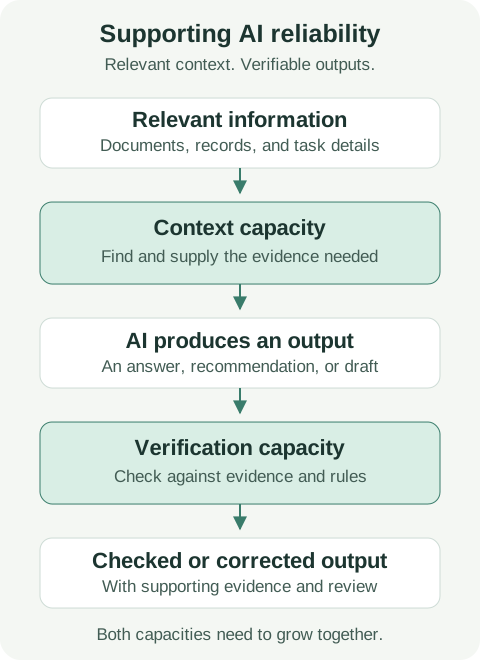
As AI systems gain access to more organisational knowledge and become involved in more consequential work, both sides need to develop together. Increasing what an AI can know without increasing the ability to verify what it says can create more capable systems without creating proportionally more dependable ones.
Context Capacity Includes Retrieval and Access
A context window determines how much information a model can process within a particular interaction. Increasing that window can allow a model to work with longer documents, larger conversations, more code, or a broader collection of supporting material.
Context capacity also includes the ability to locate relevant organisational information and make it available at the point where the model needs it.
Retrieval provides one mechanism, described in Microsoft's RAG design and evaluation guide:
A retrieval system can select documents, records, policies, or other information related to the current task. The retrieved material becomes part of the model's working context.
This is particularly important for organisational knowledge. Internal procedures, product documentation, customer information, technical specifications, contracts, operational records, and company policies may never have been part of a model's original training data, and even previously learned public information may have changed.
Retrieval and connected systems can make that information available when needed. The model and the surrounding information architecture together determine what knowledge the AI system can use.
That distinction becomes increasingly important in enterprise AI. A useful question is: "What reliable information can the system make available to the model for this task?"
More Context Does Not Automatically Mean Better Context
Increasing information access introduces another problem: the model can now receive irrelevant, outdated, contradictory, incomplete, or incorrect information. A large context containing poor evidence can be less useful than a smaller context containing the right evidence.
Data quality therefore becomes part of AI reliability. If customer records are duplicated, policies are outdated, product specifications conflict, or documents have unclear ownership, retrieval can faithfully deliver unreliable information to the model.
The AI may then produce an answer that appears well grounded because it came from an internal source. The real problem is that the source itself was wrong.
Grounding ties AI outputs to supplied information so that their basis can be examined. A grounded answer can be based on retrieved documents, database records, application state, or other evidence relevant to the task.
However, grounding is only as strong as the context supplied:
If retrieval misses the document containing an important exception, the model can still produce a well-written answer based on incomplete evidence. Nothing about fluent generation necessarily reveals that a critical source was absent.
This creates the problem of context completeness. The system needs enough relevant information to support the conclusion being requested.
Suppose an employee asks whether a customer qualifies for a particular refund. The AI retrieves the standard refund policy and correctly interprets it, but fails to retrieve a separate policy covering enterprise contracts.
The answer can be perfectly grounded in the information it received while still being wrong for that customer.
Context quality therefore has several dimensions. The information should be relevant, sufficiently current, trustworthy, and complete enough for the decision being made.
That last requirement is difficult because an AI system cannot always know what it failed to retrieve.
Verification Capacity Determines Whether Outputs Deserve Trust
Once an AI system has produced an output, a second set of capabilities becomes important. Verification capacity is the ability to evaluate whether that output is sufficiently correct, supported, safe, and appropriate for its intended use.
Different outputs require different forms of validation. Generated code can be compiled and tested, calculations can sometimes be recomputed, extracted fields can be compared against source documents, factual claims can be checked against authoritative records, and workflow actions can be tested against business rules.
For knowledge-based outputs, fact checking and source traceability become particularly valuable. If an AI system claims that a policy requires a particular action, users should be able to identify the supporting policy and check the claim against it.
The verification path becomes:
Traceability creates a path from the generated output to its supporting evidence, making mistakes easier to investigate and important claims easier to challenge.
The quality of that connection matters. A response can cite a real document that does not actually support the claim being made, so verification cannot stop at the existence of a source reference.
Output validation should ask whether the evidence supports the specific conclusion. For higher-consequence applications, that may require deterministic rules, additional systems, independent models, automated checks, or human review.
Verification should be proportionate to the consequences of being wrong. The NIST AI Risk Management Framework provides a broader structure for assessing and managing those risks.
Uncertainty Should Change What Happens Next
One of the hardest reliability problems appears when an AI system cannot determine whether it has enough information. A model may produce fluent output even when evidence is weak, contradictory, or incomplete.
A reliable AI workflow therefore needs some way to recognize or respond to uncertainty. A model's self-reported confidence can be unreliable, so the workflow needs evidence against which to assess its output.
Uncertainty can sometimes be inferred from the surrounding evidence. Retrieval may return weak matches, required fields may be missing, multiple authoritative sources may disagree, a validation rule may fail, or the request may fall outside conditions covered during evaluation.
Those signals can change the workflow:
This is where human review becomes most useful. Asking a person to approve every AI output can turn review into a mechanical confirmation step when volumes are high.
Review is more valuable when it is targeted toward ambiguity, high-consequence decisions, failed checks, unusual inputs, contradictory evidence, or situations where automated verification is weak. The reviewer contributes judgment where the automated checks are insufficient.
Correction mechanisms matter for the same reason. When the available evidence is insufficient, a reliable system should be able to ask for missing information, retrieve another source, route the task elsewhere, or stop without reaching a conclusion.
Automated Evaluation Lets Verification Scale
Human review becomes expensive when AI systems produce thousands or millions of outputs. Verification capacity therefore has to include automated evaluation if it is going to scale with AI usage.
Some evaluations can be deterministic. A generated API response can be checked against a schema, code can run through tests and static analysis, required document fields can be validated, and numerical outputs can be compared with calculations from trusted systems.
Other evaluations are probabilistic. AI systems may be evaluated against representative test sets to measure whether they follow instructions, retrieve the correct evidence, produce acceptable answers, or avoid known failure patterns.
The important distinction is between generation and evidence. If the same model generates an answer and then simply declares its own answer correct, the second step may repeat the assumptions that produced the first.
Stronger verification uses independent signals where practical:
The amount of independence required depends on the task. Low-risk content assistance may tolerate lightweight evaluation, while an AI system influencing financial, legal, security, medical, or other consequential processes requires stronger evidence.
Automated evaluation needs to measure typical performance and examine realistic failure cases. A system that performs well on ordinary questions may still fail badly when sources conflict, context is missing, requests are ambiguous, or unusual inputs appear.
Verification capacity includes testing successful outcomes and checking whether the AI fails safely when reliable answers are unavailable.
Monitoring Extends Verification Into Production
Pre-deployment evaluation can establish that an AI system worked under a set of tested conditions. It cannot guarantee that those conditions will remain unchanged.
Organisational documents are updated, databases evolve, retrieval indexes become stale, models change, user behaviour shifts, and new use cases appear. A reliable system therefore needs continuous monitoring after deployment.
Monitoring can look for signals such as failed retrievals, unsupported answers, validation failures, user corrections, unusual output patterns, latency changes, model errors, changes in source coverage, and other indicators relevant to the application.
This creates an operational reliability loop:
Error detection should connect to an actual correction mechanism. Depending on the problem, correction might involve updating a source document, fixing retrieval, changing a prompt, modifying application logic, adding a validation rule, retraining or replacing a model, or changing where human review occurs.
Feedback loops are valuable because production failures often expose gaps that pre-deployment evaluation missed. A user correction can reveal a missing policy, a retrieval failure can expose poor metadata, and repeated validation failures can identify a class of questions the system should handle differently.
Feedback should lead to reviewed changes whose effects can be checked.
Auditability Connects Context, Decisions, and Corrections
When an AI system produces an important output, organisations may need to reconstruct what happened later. That requires a record of the inputs, processing, checks, and actions that led to the answer.
Auditability means preserving enough information to understand the path that produced an outcome. Depending on the system and its privacy requirements, that can include the model or service used, relevant version information, retrieved sources, important inputs, validation results, tool actions, human approvals, and subsequent corrections.
The useful chain is:
If an error appears later, that history makes it possible to distinguish several very different failures. The source data may have been wrong, retrieval may have selected the wrong information, the context may have been incomplete, the model may have misinterpreted correct evidence, or a human may have approved an output despite a warning.
Those failures require different corrections. Without traceability, they can all collapse into the unhelpful conclusion that "the AI got it wrong."
Auditability supports accountability and helps the organisation learn from failures and decide which part of the system needs to change.
Reliable AI Needs Both More Knowledge and More Evidence
There is a natural tendency to improve AI systems by giving them more information. Larger context windows, better retrieval, connected enterprise systems, richer organisational knowledge, and improved data pipelines can all make AI substantially more useful.
Every increase in context capacity expands what the system can attempt. An AI assistant that knows only generic information has a limited role, while one connected to internal policies, customer records, operational systems, and company knowledge can participate in much more consequential work.
Verification capacity needs to grow alongside that capability.
The balance matters more than either dimension in isolation. Excellent verification cannot compensate for consistently missing the information required to answer a question, while perfect retrieval cannot guarantee that the model interprets that information correctly.
Reliable AI therefore requires a complete chain: relevant information must be available, retrieval must place the right evidence into context, data quality must make that evidence worth using, and grounding must connect generation to it. Verification then needs to check important outputs, preserve source traceability, recognize uncertainty, involve humans where appropriate, and continue monitoring behaviour after deployment.
When errors occur, auditability and feedback loops should help teams trace their causes and make corrections. The objective is a system that prevents mistakes where possible, detects them when they occur, and uses the findings to improve subsequent behaviour.
AI reliability grows when context capacity and verification capacity grow together. Giving AI access to more knowledge expands what it can do; building equally strong mechanisms for validation, traceability, monitoring, human review, and correction determines how much of that capability an organisation can actually trust.