
AI systems can influence decisions, generate content, automate work, recommend actions, and increasingly operate inside important business processes. That creates a governance problem that is broader than whether a model is technically accurate.
An AI system can perform well in testing and still create problems in production. It may behave differently for different groups, expose sensitive information, become unreliable when its inputs change, create security risks, produce outputs users cannot adequately challenge, or simply be used for a purpose that carries more risk than the organisation realised.
AI governance is the system of policies, responsibilities, controls, and oversight used to ensure AI is developed and used responsibly throughout its lifecycle. It turns broad goals such as responsible AI, fairness, transparency, privacy, safety, and accountability into operational decisions about who can use AI, for what purposes, under what controls, and what happens when something goes wrong.
The basic model is:
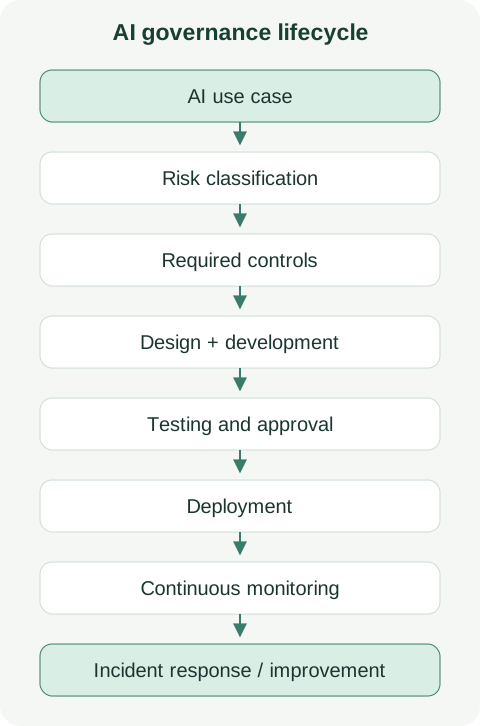
Governance continues after approval. AI risks can change as models, data, users, integrations, regulations, and operating conditions change, so governance has to follow the system throughout its lifecycle.
AI Governance Turns Responsible AI Into Accountability
Responsible AI describes the broader objective of developing and using AI in ways that are trustworthy, lawful, safe, and consistent with organisational values. AI governance provides the structures needed to turn those intentions into repeatable practice.
A policy might establish that high-impact AI decisions require meaningful human oversight, for example. Governance then has to answer the operational questions behind that principle: which systems qualify, who performs the review, what information reviewers receive, when they can override the AI, how decisions are documented, and who is accountable if the process fails.
This is why accountability is central to AI governance. Every important AI system should have identifiable ownership.
Different responsibilities may belong to different people. A business owner may be accountable for the use case, technical teams for implementation and monitoring, data owners for data quality and access, security teams for security controls, and risk or compliance functions for independent review.
Human oversight should be designed with the same care. Simply placing a person somewhere in the workflow does not guarantee meaningful control if that person cannot understand the AI's role, challenge its output, obtain additional evidence, or stop the process when necessary.
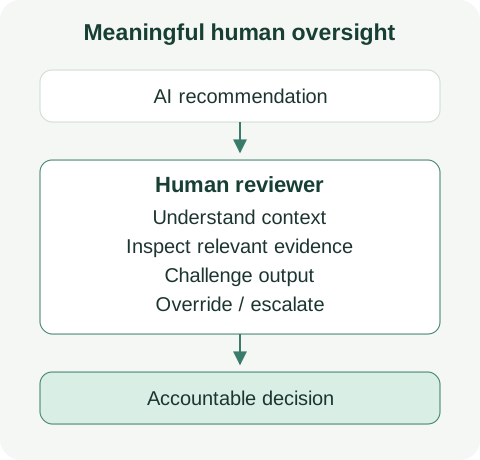
The appropriate level of oversight depends on the consequences of the decision. An AI system suggesting internal document tags does not necessarily need the same governance as one influencing employment, credit, healthcare, safety, or access to essential services.
Good governance is therefore risk-based, with controls matched to the potential consequences of each use case.
Risk Classification Determines How Much Governance an AI System Needs
AI risk management begins by understanding what the system does and what could happen if it fails or is misused. A low-impact productivity tool and an AI system involved in consequential decisions should not automatically go through identical approval and monitoring processes.
A risk classification can consider factors such as the system's purpose, affected population, degree of autonomy, sensitivity of the data, reversibility of outcomes, scale of deployment, security implications, and severity of potential harm. The classification can then determine which controls are required before and after deployment.
Risk classification gives AI ethics a practical role in system design and review. Concerns about fairness, privacy, autonomy, safety, and human welfare need to be translated into risks that can be investigated and managed for a specific use case.
Fairness and bias are good examples. It is not enough for a governance policy to say that AI must be unbiased, because fairness can mean different things in different contexts and no single metric resolves every problem. Teams need to identify who could be affected, examine relevant data and outcomes, choose appropriate evaluation methods, and determine what differences would be unacceptable for the particular application.
Transparency and explainability require similar context. Transparency may involve informing people that AI is being used, documenting the system's purpose and limitations, identifying the data and model involved, or recording how an automated process contributed to an outcome. Explainability is more specifically concerned with making the system's behaviour or particular outputs understandable enough for the people who need to interpret, challenge, audit, or act on them.
Privacy and data governance apply throughout data collection, use, storage, and disposal. Governance needs to consider why data is being processed, whether its use is permitted, who can access it, how long it is retained, whether sensitive information can appear in model inputs or outputs, and whether training or inference creates new privacy risks.
Security, resilience, and model safety add another layer. AI systems still face familiar cybersecurity concerns involving confidentiality, integrity, availability, software dependencies, credentials, infrastructure, and access control, while also introducing AI-specific questions around model behaviour, adversarial inputs, unsafe outputs, model or data manipulation, and reliance on external AI services. NIST explicitly includes characteristics such as safety, security and resilience, accountability and transparency, explainability, privacy, and fairness in its description of trustworthy AI.
Risk classification connects the characteristics of an AI system to proportionate governance controls.
Impact Assessments and Documentation Make AI Risk Reviewable
Governance becomes difficult when nobody can reconstruct why an AI system was approved. An organisation may know that a model exists without having a reliable record of its purpose, intended users, data, limitations, evaluations, dependencies, or accountable owner.
An AI impact assessment creates an opportunity to examine these questions before deployment. Depending on the use case, it can document the intended benefit, affected people, reasonably foreseeable harms, data implications, degree of automation, human oversight, security considerations, potential bias, regulatory requirements, and controls intended to reduce identified risks.
The assessment should connect naturally to model and system documentation. Useful documentation can describe what the model or AI system is intended to do, what it should not be used for, relevant data and dependencies, known limitations, evaluation results, ownership, version information, and the conditions under which it was approved.
Documentation needs to cover the components and workflow that connect a model to real-world outcomes:
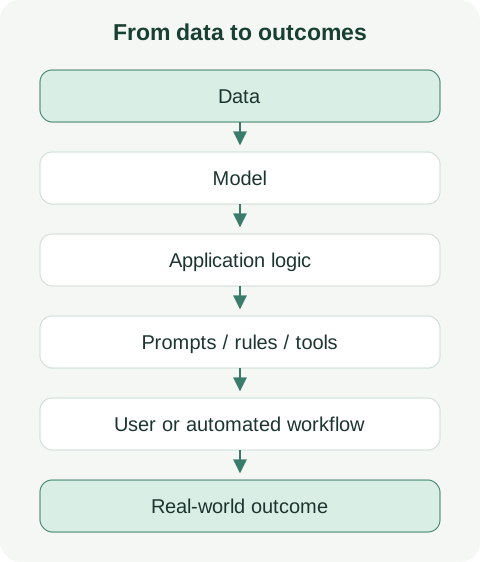
A model may perform acceptably in isolation while the complete application creates risks through poor prompts, inappropriate automation, missing access controls, unreliable external tools, or a workflow that gives users too much confidence in its outputs.
Testing and evaluation therefore need to examine the deployed system in context. Technical performance may be one dimension, but evaluation can also include robustness, safety, security, privacy, fairness, failure modes, human interaction, and whether the system remains within the boundaries established during its risk assessment.
Testing requirements should again be proportionate to risk. Governance should produce enough evidence for an organisation to make a defensible decision about whether a particular system is ready for its intended use.
Governance Continues After an AI System Is Deployed
Pre-deployment evaluation cannot predict every condition an AI system will encounter. Production inputs change, user behaviour evolves, external models receive updates, attackers discover new techniques, and systems can gradually be used for purposes broader than the ones originally approved.
That makes continuous monitoring a shared responsibility for engineering teams and governance owners. Organisations may need to monitor performance, errors, unusual usage, security events, output quality, complaints, fairness indicators, data drift, model changes, and other signals appropriate to the system.
Monitoring should connect to thresholds and actions. Detecting a problem is much less useful if nobody knows who receives the alert, what constitutes a serious incident, whether the system should be restricted or disabled, and who has authority to make that decision.
An AI incident management process provides that escalation path. Incidents might involve harmful outputs, privacy exposure, unexpected discrimination, security compromise, material model failures, prohibited usage, or another situation in which the AI system behaves outside its approved risk boundaries.
The lifecycle then forms a feedback loop:
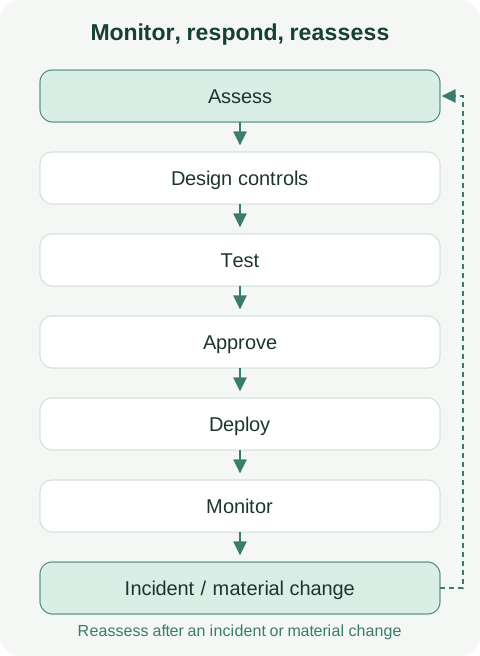
Material changes may need reassessment even when no incident occurs. Replacing the underlying model, introducing new data, adding autonomous tool use, expanding into another market, or moving from internal assistance to customer-facing decision-making can change the system's risk profile substantially.
This is the central idea behind AI lifecycle governance. Governance should follow the use case from initial proposal through development, acquisition, deployment, operation, modification, and eventual retirement.
Third-Party AI Does Not Outsource Accountability
Many organisations will not train their own models. They will buy AI-enabled software, call external model APIs, adopt cloud AI services, or allow employees to use third-party AI products.
That changes where some technical responsibilities sit, but it does not eliminate the organisation's own governance responsibilities.
Third-party AI risk can include uncertainty about training data, model changes, security practices, data retention, geographic processing, availability, subcontractors, evaluation evidence, intellectual property, regulatory obligations, and what happens to organisational data submitted to the service.
The organisation also controls something the provider cannot fully control: how the AI is used inside the organisation's own business process. A general-purpose model used to brainstorm marketing copy creates a different risk profile from the same model connected to customer records and allowed to trigger operational actions.
Third-party governance should therefore connect procurement with the wider AI lifecycle. Before adoption, the organisation needs enough information to classify the use case and evaluate the supplier; after deployment, it needs a way to track material provider changes and determine whether those changes require reassessment.
This is especially important with rapidly changing AI services. A system can change even when the organisation has not deployed new application code because the external model or service it depends on may have changed.
NIST AI RMF, ISO/IEC 42001, and the EU AI Act Address Different Parts of the Governance Problem
Organisations do not have to invent AI governance entirely from scratch. Frameworks, management-system standards, and legislation increasingly provide structures for managing AI risk, although they serve different purposes and should not be treated as interchangeable.
The NIST AI Risk Management Framework (AI RMF) is a voluntary, non-sector-specific framework intended to help organisations manage AI risks and incorporate trustworthiness considerations into the design, development, use, and evaluation of AI systems. NIST released AI RMF 1.0 in January 2023 and subsequently published a Generative AI Profile; as of September 2026, NIST says AI RMF 1.0 is being revised.
NIST's framework treats risk management as an activity that spans the AI lifecycle. Its trustworthiness framing includes characteristics such as validity and reliability, safety, security and resilience, accountability and transparency, explainability and interpretability, privacy enhancement, and fairness with harmful bias managed.
ISO/IEC 42001:2023 approaches the problem as an AI management system. ISO describes it as the first AI management system standard and specifies requirements for establishing, implementing, maintaining, and continually improving an Artificial Intelligence Management System within an organisation.
That management-system perspective helps embed governance in organisational operations, with responsibilities distributed across the teams involved. Responsibilities, risk assessment, controls, oversight, continual improvement, and organisational processes can then operate as a managed system.
The EU AI Act provides the legislative component of this governance landscape. It establishes legal requirements using a risk-based regulatory structure, with obligations depending on the type of AI system and the role of the organisation involved.
Its requirements take effect in stages. As of September 2026, the European Commission's AI Act Service Desk states that general provisions and prohibitions began applying in February 2025, rules for general-purpose AI began applying in August 2025, and the majority of the Act's rules and relevant enforcement started on 2 August 2026. Following 2026 amendments, certain high-risk rules now apply later, including 2 December 2027 for Annex III high-risk systems and 2 August 2028 for high-risk systems embedded in regulated products.
These three sources contribute to governance in complementary ways:
| Source | Primary role | What it contributes |
|---|---|---|
| NIST AI RMF | Voluntary risk-management framework | Structured approach to identifying and managing trustworthy AI risks |
| ISO/IEC 42001 | AI management-system standard | Organisational system for governing and continually improving AI management |
| EU AI Act | Regulation | Legal obligations for AI systems and actors within its scope |
An organisation may use risk-management practices informed by NIST, establish management processes aligned with ISO/IEC 42001, and separately determine which legal obligations apply under the EU AI Act or other relevant laws. NIST itself provides crosswalks intended to help organisations align the AI RMF with other frameworks and international standards.
AI Governance Is Ultimately a Lifecycle Control System
AI governance works when it changes what happens to real AI systems. Policies should affect which use cases are approved, risk classification should determine controls, assessments should expose potential harms, testing should produce evidence, and monitoring should reveal when the assumptions behind an approval are no longer true.
That requires a connected governance process:
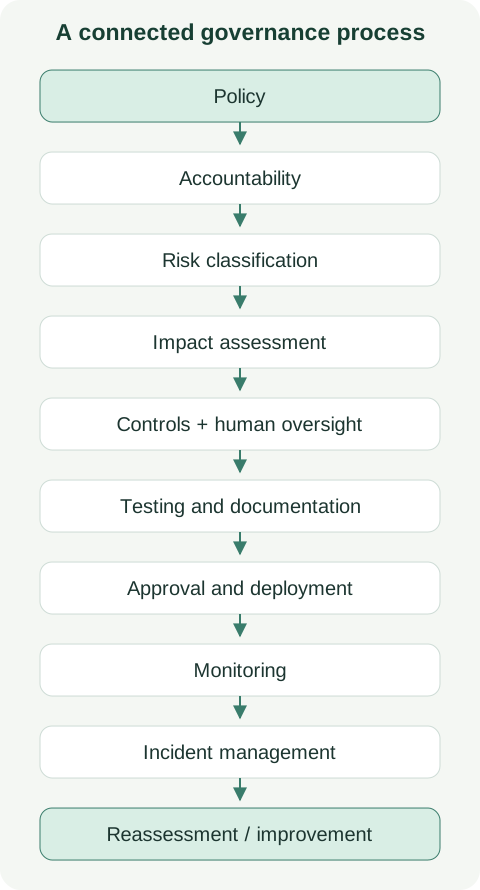
Fairness, transparency, explainability, privacy, security, resilience, safety, and ethics fit inside this process as properties and risks that need to be considered for the particular system. Regulatory compliance adds requirements that depend on jurisdiction and use case, while frameworks such as NIST AI RMF and standards such as ISO/IEC 42001 provide structures organisations can use to make those activities more systematic.
The strongest governance programmes also avoid treating compliance as the finish line. An AI system can satisfy a documented control and still create a new problem in production, while a previously acceptable system can become riskier when its model, data, users, or purpose changes.
AI governance creates an accountable system for making and revisiting decisions about AI. It establishes who owns the risk, how that risk is classified and tested, what evidence is required before deployment, how people retain appropriate oversight, and how the organisation detects and responds when reality no longer matches the assumptions under which the AI was approved.